

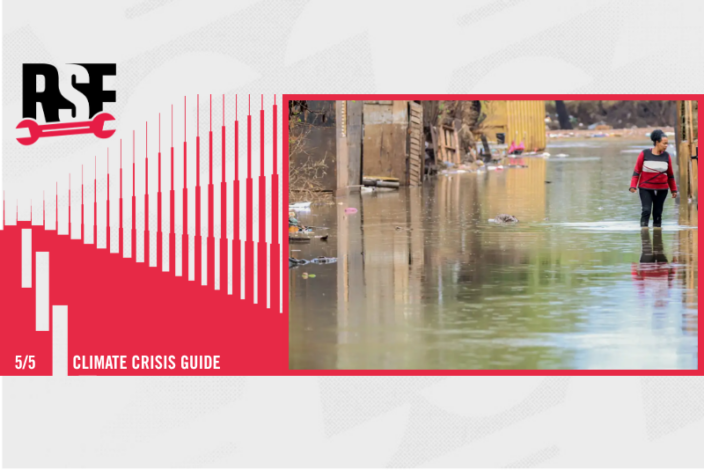

The increase in the frequency of extreme events and, consequently, in media coverage of the subject, makes it clear: the climate can no longer be considered a distant political issue, disconnected from the daily lives of the population. Furthermore, in order for journalists to be able to work competently, thoroughly and appropriately, it is essential that media outlets give the issue the importance it deserves.
Based on interviews with environmental communication researcher Eloisa Loose and journalist Kyle Pope, co-founder of the Covering Climate Now observatory, here are some important guidelines for covering extreme events beyond the tragedy:
- Connected agenda: the environmental issue should be related to areas such as politics, economics, etc., with possibilities for different frameworks.
- Systemic and critical approach: from the origins of the disaster to possible solutions and the reconstruction phase, assessing whether the measures are truly resilient. Attention: the focus should be on environmental issues, but the most devastating negative impacts always affect the most vulnerable communities, perpetuating a situation of climate injustice.
- Training of journalists: a consistent base of information about the environment and circumstances that can lead to disasters. Remembering that, often, public authorities have conflicting information about what is happening.
Understanding the public policies that govern cities is essential to understanding the use of urban space, which is so closely linked to extreme events.
Training tailored to the local reality and the editorial proposal of each media outlet, rather than generic courses that may have a limited effect.
Expansion and diversification of sources, so as not to be exclusively dependent on official sources, such as the Civil Defence, which may have limited information disclosure due to internal protocols. Local researchers, environmental agency technicians, professional councils, and movements and projects that discuss vulnerabilities are important sources for treating information more comprehensively.
Collaboration among colleagues A pre-existing support network can be vital for the continuity of news coverage during an emergency. These collaborations should be established before times of crisis.
Decentralisation It is essential to understand the global picture, but no less important to understand the specific vulnerabilities of the location where you will be reporting. To do this, it is necessary to map out critical infrastructure points in advance, such as roads and motorways that may be affected, as well as to be aware of the authorities’ plans for these situations.
- Localise: climate coverage should focus on what is happening in the reader’s community, not on reports or events in other parts of the world.
- Humanise: Do not focus solely on data and research. Interview people and recount their experiences, obviously respecting each person’s circumstances and limits and their willingness or unwillingness to give statements.
- Offer solutions: avoid gloomy and apocalyptic coverage. It is crucial to show that there are actions and solutions that can be taken – many of which already exist and do not need to be invented.
Climate Crisis Safety Guide for journalists
You can access the full pdf versions of the guide:
(English – Portuguese – Spanish – Traditional Chinese – Simplified Chinese)