

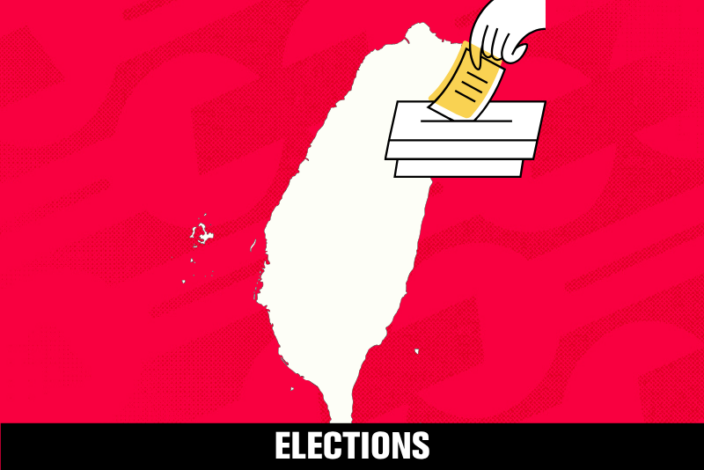

Propaganda remains a persistent challenge to Taiwan’s democracy, particularly in the lead-up to local elections. China, a country known for its military tensions with the island nation and its attempts at foreign influence, is a highly likely source of electoral interference, notably by disseminating misleading information. In this second article of the three-part series The Propaganda Playbook, Reporters Without Borders (RSF) examines recurring propaganda narratives targeting the Taiwanese information space and offers practical guidance on how to assess the claims behind them.
Propaganda narratives may not always contain fabricated facts. Real events, political debates and legitimate concerns are often selected and reframed to promote a particular message.
Four questions to keep in mind
Journalists should keep an eye out for recurring propaganda tactics such as presenting facts without context, conclusions that stretch beyond tangible evidence and interpretations presented as fact.
Before reporting a potentially misleading claim, ask yourself about the:
1. Source: Where does the information come from?
Trace the claim back to its original source. Check who produced it, whether the source is reliable and whether the original statement has been accurately quoted or represented.
2. Evidence: What is fact, and what is interpretation?
Distinguish verified information from opinion, speculation and predictions. Check whether the available evidence supports the claim, rather than simply repeating the conclusion drawn from it.
3. Context: Does the evidence support the conclusion?
Consider the circumstances in which a statement was made or an event occurred. Be particularly cautious about claims that attribute an outcome to a single cause or present a possible scenario as inevitable.
4. Omissions: What information is missing?
Look for relevant details, alternative explanations or contradictory evidence that could change how the claim is understood. Consider whether statistics, quotations and events have been selectively presented
The objective is not to dismiss a claim simply because it resembles a known propaganda narrative. It is to recognise the narrative, identify how it is constructed and verify the evidence before reproducing it.
Examples of recurrent propaganda narratives
“A DPP victory would mean war”
Beijing has repeatedly portrayed Taiwan’s Democratic Progressive Party (DPP) and President Lai Ching-te as responsible for rising cross-strait tensions. As elections approach, this translates into claims that a DPP victory would inevitably lead to war with China. Taiwan’s military preparations may be described as “provocations”, while responses to Chinese military exercises or grey-zone activities may be presented as evidence that Taipei is escalating tensions.
What should journalists check?
- Is the claim predicting what will happen, or reporting something that has already happened?
- What evidence supports the claimed link between a DPP victory and military action by China?
- Is Taiwan’s action being presented without reference to China’s preceding actions or the broader context?
- What does the original source actually say?
“The United States cannot be relied on as an ally”
Questions about the extent and conditions of US support for Taiwan are part of an ongoing international policy debate. Some of the underlying debate is real. US politicians have questioned Washington’s commitment to Taiwan. But these statements can be expanded into the claim that the US is only interested in Taiwan for its semiconductor industry, that it treats Taiwan as a pawn and would abandon the island state when it no longer serves US interests. Real events can be used to reinforce a political narrative through selective interpretation. For example, TSMC, Taiwan’s leading semiconductor manufacturer, is investing in chip production facilities in Arizona. This investment may be portrayed as evidence that the US is deliberately weakening Taiwan’s semiconductor industry, although the investment alone does not prove this intention.
What should journalists check?
- What did the US official actually say, and in what context?
- Is a political debate being presented as an established US strategy?
- Does one real event support the broader conclusion being drawn from it?
- Is the original evidence being presented in full?
A genuine fact does not necessarily make the narrative built around it true.
“The decline of the United States means the rise of China”
A third common narrative presents China as an increasingly powerful alternative to the United States — and, by extension, suggests that Taiwan should reconsider its relationship with Washington D.C. Beijing’s propaganda tends to highlight China’s economic development, technological capabilities or the quality of life it provides its inhabitants, while portraying criticism of China as politically motivated or based on false information. International tensions involving the US are then used to reinforce the idea that US influence is declining and China is becoming the inevitable dominant power.
What should journalists check?
- Who produced the information?
- What data is being used to demonstrate China’s supposed advantage?
- Are the figures comparable and independently verifiable?
- What information or contradictory evidence has been left out?
- Is a prediction or political interpretation being presented as a fact?
This article was written by Brian Hioe, a journalist based in Taipei, Taiwan. He covers a wide range of topics related to Taiwan and East Asia. His work provides a local perspective on the political, social and economic developments shaping the region.
More resources
- The Propaganda Monitor — China: Investigations into Chinese propaganda and its influence on global media.
- Decoding Online Disinformation: Resources for understanding and investigating online disinformation.
- Dealing with Deepfakes: Practical advice on identifying deepfakes, responding to attacks targeting journalists, and supporting affected journalists.